Tampilkan postingan dengan label Info/News. Tampilkan semua postingan

Senin, 29 Agustus 2016

This USB Drive Can Destroy Any UnProtected Electronic Device


Welcome to the USB Kill 2.0.

Thus begins the page for this USB Killer device. This tiny and compact sized USB drive looks like just any other drive. Excep for one thing.

This USB drive can kill anything that can be connected to it electronically. Though that is not its original intent, it can be used for doing just that.

What Does the USB Killer Do?

In case you haven’t figured out, this USB killer device will end up frying that LCD TV, laptop, computer, MP3 stereos and even kitchen fridges that come with a USB port. It works by sending an electric surge to the electronics it is connected to.

Created by a researcher who only calls himself Dark Purple, the 2.0 version of the USB Kill delivers -200VDC of shocks as compared to -100VDC of its predecessor.

The USB works by charging its capacitors from USB power lines. Once charged, it discharges -200VDC at the host device that is connected via data lines. It keeps on releasing high voltage electricity, until the USB Kill device is removed.

A Tool Of Destruction and Havoc?

Why exactly would anyone sell this then? Just imagine the damage this device would leave in its wake.

The maker behind the USB Kill 2.0 says that such USBs are meant to be used to check surge protection on electronics that are protected against high voltage surges. Plus, the device is meant to be paired with the USB Killer Protection Shield, a doohickey that ensures that the USB drive doesn’t kill the host device.

In layman’s terms, on any unprotected hardware (read tvs, laptops, etc), this drive can fry electronics that can’t handle high voltages.

In case we want to go into the specifics of how much havoc the USB Kill device causes to its hosts, Ars Technica also presumes that the device could end up damaging the USB port at least, or the motherboard of the USB host device.

See it in action here:

Source: https://propakistani.pk/2016/08/29/usb-drive-can-destroy-unprotected-electronic-device/

Kamis, 25 Agustus 2016

Apple releases 'Emergency' Patch after Advanced Spyware Targets Human Rights Activist


Apple has released iOS 9.3.5 update for iPhones and iPads to patch three zero-day vulnerabilities after a piece of spyware found targeting the iPhone used by a renowned UAE human rights defender, Ahmed Mansoor.

One of the world's most invasive software weapon distributors, called the NSO Group, has been exploiting three zero-day security vulnerabilities in order to spy on dissidents and journalists.

The NSO Group is an Israeli firm that sells spying and surveillance software that secretly tracks a target's mobile phone.

The zero-day exploits have allowed the company to develop sophisticated spyware tools that can access the device location, contacts, texts, calls logs, emails and even microphone.

Apple fixed these three vulnerabilities within ten days after being informed by two security firms, Citizen Lab and Lookout, who conducted a joint investigation.

Background Story: Malware Discovery


Mansoor, 46, ‘Martin Ennals Award’ winner from the United Arab Emirates, received a text message on his iPhone on August 10, from an unknown number.

Mansoor found the message suspicious and knowing that government hackers had already targeted him in the past, he forwarded that message directly to Citizen Lab researcher Bill Marczak.

Citizen Lab brought in Lookout, a San Francisco mobile security company, to help examine the message.

After analyzing the message content, the researchers found that the link led to a sophisticated piece of malware that exploited three different unknown flaws in Apple’s iOS that would have allowed the attackers to get complete control of Mansoor’s iPhone.


Those links, if clicked, "Mansoor’s iPhone would have been turned into a sophisticated bugging device controlled by UAE security agencies," the Citizen Lab explained in a blog post.

"They would have been able to turn on his iPhone’s camera and microphone to record Mansoor and anything nearby, without him being wise about it. They would have been able to log his emails and calls — even those that are encrypted end-to-end. And, of course, they would have been able to track his precise whereabouts."

According to a blog post published by Lookout, the three zero-day flaws, dubbed "Trident" by the firm, involved:
  • A memory corruption vulnerability in WebKit that could allow hackers to exploit a device when a user clicks on a malicious link.
  • Two kernel bugs (allowing device jailbreak) that an attacker secretly installs malware on victim’s device to carry out surveillance.
Apple released the patch update, iOS 9.3.5, on Thursday, and labeled it "important," advising its users to install the latest version of iOS as soon as possible to protect their devices against these potential security exploits.

You can install the security update over-the-air (OTA) via your iPhone or iPad's settings.
Source: http://thehackernews.com/2016/08/apple-security-update.html

WhatsApp to Share Your Data with Facebook — You have 30 Days to Stop It


Nothing comes for Free, as "Free" is just a relative term used by companies to develop a strong user base and then use it for their own benefits.

The same has been done by the secure messaging app WhatsApp, which has now made it crystal clear that the popular messaging service will begin sharing its users’ data with its parent company, Facebook.

However, WhatsApp is offering a partial opt-out for Facebook targeted ads and product related purposes, which I will let you know later in this article, but completely opting out of the data-sharing does not seem to be possible.

Let's know what the company has decided to do with your data.

Of course, Facebook is willing to use your data to sell more targeted advertisements.

WhatsApp introduced some significant changes to its privacy policy and T&Cs today which, if accepted once, gives it permission to connect users' Facebook accounts to WhatsApp accounts for the first time, giving Facebook more data about users for delivering more relevant ads on the social network.

The messaging service will also begin pushing users to share some of their account details, including phone numbers, with Facebook, allowing the social network to suggest phone contacts as friends.

When Facebook acquired WhatsApp for $19 Billion in 2014, users were worried about the company's commitment to protecting its users' privacy. But, WhatsApp reassured them that their privacy would not be compromised in any way.

"Respect for your privacy is coded into our DNA, and we built WhatsApp around the goal of knowing as little about you as possible," said WhatsApp co-founder Jan Koum in a blog post published at that time.

Now the WhatsApp users are feeling betrayed by the company's latest move.

However, you need not to worry about the contents of your WhatsApp messages, like words and images, as they are end-to-end encrypted, meaning that even the company cannot read them.

Ultimately, the two companies will be sharing, what they called, a limited amount of user data, which includes phone numbers and other information about users.

No Option to Completely Opt-Out of Data Sharing


If you think WhatsApp is more privacy conscious than Facebook’s Messenger, it is not anymore.

WhatsApp is offering a solution partially to opt out the data sharing, specifically for Facebook ad targeting and product-related purposes.

However, the company notes that data will still be shared "for other purposes such as improving infrastructure and delivery systems, understanding how our services or theirs are used, securing systems, and fighting spam, abuse, or infringement activities."

So, those who are thinking to opt out of the data-sharing entirely: There's no possible way to opt totally out.

Though one short solution is to stop using WhatsApp.

Here's How to opt -out of sharing data for Facebook ad-targeting purpose:


The company has outlined two ways to opt out of the exchange of information with Facebook on its blog.

One way is for those users who have not yet agreed to the new terms of service and privacy policy, so before agreeing to the new terms, follow these simple steps:
  • When prompted to accept the updated T&Cs, tap Read to expand the full text.
  • A checkbox option at the bottom of the policy for sharing your data on Facebook will appear.
  • Untick this option before hitting Agree. This will let you opt out of the data-sharing.
The second option is for those who have already accepted the new T&Cs without unchecking the box to share their information with Facebook.

WhatsApp is also offering a thirty-day window for users to make the same choice via the settings page in the app. To exercise your opt-out in this scenario you need to follow these steps:
  • Go to Settings → Account → Share my account info in the WhatsApp app
  • Uncheck the box displayed there within 30 days, as after that this partial opt-out window will expire.
However, WhatsApp states Facebook will still receive your data in some situations.

After introducing end-to-end encryption, WhatsApp has become one of the most popular secure messaging apps, but this sudden shift in its privacy policy may force some users to switch to other secure apps like Telegram and Signal.
Source: http://thehackernews.com/2016/08/facebook-whatsapp.html

Brain Malware — Here’s How Hackers Can Get Inside Your Head


For a moment, forget computer and smartphone malware. There’s even a bigger danger in town in the form of brain malware. By exploiting brain-computer interfaces (BCI) being used in medical and gaming applications, hackers can read your private and sensitive data. Recently, a team of researchers from the University of Washington shed more light on the subject, demanding a policy-oriented regulation on BCIs.

Imagine a scenario where you are dealing with your online bank accounts or browsing your favorite social network, and someone is busy reading your mind–gathering you most sensitive and private information.

While you might call this fictitious, researchers are busy exploring such situations and conducting experiments. With the advent of brain-computer interfaces (BCI), that are already being used for medical and non-medical purposes, there’s a need to implement some method to secure our brain signals from being misused.

The researchers at the University of Washington in Seattle, talking to Motherboard, say that there’s actually very little time. “If we don’t address this quickly, it’ll be too late,” they say.

Motherboard’s Victoria Turk recently interacted with Howard Chizeck, who is working Tamara Bonaci, and her team. They strapped Turk into a BCI swimcap to play Flappy Whale and recorded her brainwaves. While doing so, the researchers were also sending messages to her brain.

Turk says that as she played along, something unusual started happening and the logos of American banks started appearing and disappearing.

Motherboard’s Victoria Turk with Tamara Bonaci
Researchers say that with this method, hackers can insert some images into apps and games, and record your brain’s response using the BCI. Doing so, hackers can know which banks they need to target or something more uncomfortable like your sexual orientation and fetishes.

The same technique can be implemented to read your mind for knowing your political or religious mindsets. Here’s what Bonaci has to say:

When you’re picking up electric signals to control an application… the application is not only getting access to the useful piece of EEG needed to control that app; it’s also getting access to the whole EEG,. And that whole EEG signal contains rich information about us as persons.

The researchers say that they haven’t perfected this art of mind-reading. But, they have been successful in reading people’s personal preferences based upon their strong emotional response. In such cases, after about 300 milliseconds of seeing a stimulus, there’s going to be a “positive peak hidden with their EEG signal.”

The researchers say that soon hackers will target people using fake and brain malware-packed games. Back in 2013, some researchers have already proved the possibility of side-channel attacks against BCIs, revealing private data like credit card pin, addresses, passwords etc.

The University of Washington researchers suggest that there should be a policy-oriented approach to figure out what’s acceptable to do with the data obtained from BCIs.

— Via Motherboard

Source: http://fossbytes.com/brain-malware-hackers-can-get-inside-head-bci/

Raspberry Pi + Docker: HypriotOS 1.0.0 Linux Brings Containers To Your Pi


HypriotOS 1.0.0 release recently arrived. It enables you to run Docker containers on entire Raspberry Pi family. HypriotOS is a Debian derivative that comes with out of the box Docker Engine 1.12.1. You need to simply install HypriotOS on your SD card using Hypriot flash tool and run a couple of commands to get this OS up and running.

If we take a look at some of the most impactful technology stories of the past few years, we can easily put Raspberry Pi, a tiny Linux-based single board computer, in the race. Earlier this year, we witnessed the launch of Raspberry Pi 3, a new version with built-in wireless and more powerful 64-bit processor.

This versatile computer already supported Linux-based operating systems and Windows 10 IoT Core. Recently we saw the release of HypriotOS v1.0.0 “Blackbeard”. It’s a new Debian derivative that’s developed to run Docker on your Pi.

Here’s what the official announcement on HypriotOS blog says:

“Today we proudly present our 1.0.0 release of HypriotOS – a container OS that takes you from Zero to Docker within 5 Minutes only, on any device of the complete Raspberry Pi family.”

It’s perhaps the first Linux distribution to offer Docker support for Raspberry Pi. Out of the box, HypriotOS v1.0.0 comes with Docker Engine 1.12.1 and the latest versions of Docker Machine and Docker Compose.

This lightweight operating system needs just 600MB of storage space to install and run. To get this OS up and running, you need to install HypriotOS flash tool and run the following command.

flash https://downloads.hypriot.com/hypriotos-rpi-v1.0.0.img.zip

After this, put your SD card into the Pi and turn on the power. After connecting to a Raspberry Pi, the booting up process just takes five minutes.

Here’s the download link: HypriotOS 1.0.0

HypriotOS 1.0.0 feature highlights:

  • Here are the major features of HypriotOS 1.0.0. Take a look:
  • Lastest Docker Engine 1.12.1 with Swarm Mode
  • All Raspberry Pi versions are supported
  • Easy flashing with HypriotOS flash tool
  • Easy installation and configuration
  • High performance out of the box
  • Enhanced security
  • Download package is just 232MB
Apart from this Docker integration, Raspberry Pi is also expected to be supported by Google’s upcoming operating system, Fuschia. Another important news comes from Redmond, that has just released the Anniversary update for Windows 10 IoT Core.

For more changes and detailed information about HypriotOS, please read the release notes.
Source: http://fossbytes.com/hypriotos-linux-distro-brings-docker-containers-to-raspberry-pi/

Rabu, 17 Agustus 2016

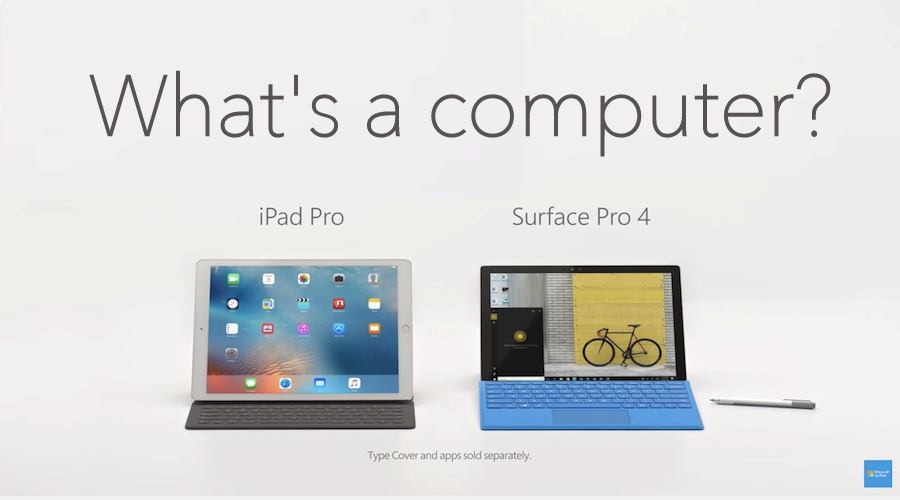
Microsoft Just Made Fun Of Apple In Its New And Hilarious Ad


In a new advertisement, Microsoft has made fun of Apple’s claim that iPad Pro is a real computer. Microsoft called Apple out on iPad Pro’s incompetence to run desktop apps and support USB devices. Looking at the devices offered by both the companies, at the moment, Microsoft Surface looks like a better “computer”.

Back in 2012, Apple CEO Tim Cook poked fun at Microsoft’s Surface tablet and called it “a fairly compromised, confusing product”. His other Apple colleagues thought that putting a keyboard on a tablet was like combining “a toaster and a refrigerator.” Well, things change with time.

Now, Apple is itself very much interested in the same business and working hard to push the sales of its iPad Pro. It’s so much engrossed in marketing iPad Pro as a computer that it has forgotten its real computer offering Apple MacBook Pro.

In an ad that people are calling silly, Apple recently implied that iPad is a complete replacement of a real computer. Given the current state of iPad Pro that comes with its mobile iOS operating system, this claim sounds childish. If you’ve missed the ad, here it is:


Now, poking fun at Apple’s claim, Microsoft has refused to accept the same. Redmond’s new Surface ad points out the problems faced by the iPad users who miss having USB port and not being able to run any desktop apps.

On the other hand, Microsoft’s Surface is more like a real computer with a complete desktop operating system and powerful hardware support.


Honestly, at the moment, if you want to do some real and serious work, Microsoft’s Surface is a better choice. We are waiting for Apple’s move because it’s an argument that won’t end here.
Source: http://fossbytes.com/microsoft-made-fun-apple-latest-ad-ipad-surface/

Jumat, 15 Juli 2016

Which Programming Languages Are Useful For Hacking


Important Programming languages for Hackers

Many of our readers often send us queries about which programming language they should learn. Some want to know quick fix hacking solutions. Almost all tech gadgets are built with coding. Every App, game or site that you use is programmed in a particular computer language. You need to know that hacking is not a click-of-a-button job but a serialized and compartmentalized vocation which uses different programming languages for different uses.

Most of the websites out there will give you list of most popular programming languages in the world. We at Techworm try to make it more easy for budding security researchers and hackers by breaking up the programming languages used by hackers.

Hacking is usually meant to break a code. There are three sections of hacking ― Web Hacking, Exploit Writing & Reverse Engineering and each of it requires different programming language


1. Web Hacking

Since most of the tech is build around world wide web, it is important to learn web hacking to be a good hacker. Let’s say you are interested in hacking web apps and/or websites then you will need to learn web coding. Websites use mostly HTML, PHP and JavaScript so it is important to learn these three.

HTML:

One of the easiest and widely used static markup web language present in each and every website you see in your browser. It’s recommended to learn HTML because it helps understanding web actions, response, and logic.

JavaScript:

JS is a client-side web programming mostly used in web sites for better user interface and quick response. If you are interested in a hacking career you need to learn JavaScript because it helps to understand client-side mechanism which is essential for finding client-side flaws.

PHP:

A dynamic server-side language which is responsible for managing web-apps and database. PHP is considered one of the most essential language because it controls everything on site and server, like a captain of a ship. It is advised to learn PHP nicely.

SQL:

SQL is responsible for storing and managing sensitive and confidential data such as user credentials, bank and personal information about the website visitors. Black hat hackers mostly target SQL database and steal information which is later sold on underground dark web forum. If you want to be good security researcher, you should learn SQL so that you can find flaws in a website and report them.

2. Exploit Writing

After web hacking, another most important feature of hacking is exploits. You can crack a particular software by writing a exploit. But to write a exploit you need to learn either Python or Ruby.

Python:

It is said that a security researcher or hacker should know Python because it the core language for creating exploits and tools. Security experts and even pro hackers suggest that master Python is the best way to learn hacking. Python offers wider flexibility and you can create exploits only if you are good in Python.

Ruby:

Ruby is a simple yet complicated object-oriented language. Ruby is very useful when it comes to exploit writing. It is used for meterpreter scripting by hackers. The most famous hacker tool, Metasploit framework is programmed in Ruby. Though Ruby may not be as versatile as Python, knowledge of Ruby is must in understanding exploits.

3. Reverse Engineering

Reverse engineering, the process of taking a software program’s binary code and recreating it so as to trace it back to the original source code. If you know reverse engineering you can find flaws and bugs easily. If you want to learn reverse engineering you need to know C, C++ and Java. The process of converting the code written in high level language into a low level language without changing the original program is known as reverse engineering.
Source: http://www.techworm.net/2016/06/programing-languages-used-hacking-process.html