Tampilkan postingan dengan label Info/News. Tampilkan semua postingan

Senin, 29 Agustus 2016

This USB Drive Can Destroy Any UnProtected Electronic Device


Welcome to the USB Kill 2.0.

Thus begins the page for this USB Killer device. This tiny and compact sized USB drive looks like just any other drive. Excep for one thing.

This USB drive can kill anything that can be connected to it electronically. Though that is not its original intent, it can be used for doing just that.

What Does the USB Killer Do?

In case you haven’t figured out, this USB killer device will end up frying that LCD TV, laptop, computer, MP3 stereos and even kitchen fridges that come with a USB port. It works by sending an electric surge to the electronics it is connected to.

Created by a researcher who only calls himself Dark Purple, the 2.0 version of the USB Kill delivers -200VDC of shocks as compared to -100VDC of its predecessor.

The USB works by charging its capacitors from USB power lines. Once charged, it discharges -200VDC at the host device that is connected via data lines. It keeps on releasing high voltage electricity, until the USB Kill device is removed.

A Tool Of Destruction and Havoc?

Why exactly would anyone sell this then? Just imagine the damage this device would leave in its wake.

The maker behind the USB Kill 2.0 says that such USBs are meant to be used to check surge protection on electronics that are protected against high voltage surges. Plus, the device is meant to be paired with the USB Killer Protection Shield, a doohickey that ensures that the USB drive doesn’t kill the host device.

In layman’s terms, on any unprotected hardware (read tvs, laptops, etc), this drive can fry electronics that can’t handle high voltages.

In case we want to go into the specifics of how much havoc the USB Kill device causes to its hosts, Ars Technica also presumes that the device could end up damaging the USB port at least, or the motherboard of the USB host device.

See it in action here:

Source: https://propakistani.pk/2016/08/29/usb-drive-can-destroy-unprotected-electronic-device/

Kamis, 25 Agustus 2016

Apple releases 'Emergency' Patch after Advanced Spyware Targets Human Rights Activist


Apple has released iOS 9.3.5 update for iPhones and iPads to patch three zero-day vulnerabilities after a piece of spyware found targeting the iPhone used by a renowned UAE human rights defender, Ahmed Mansoor.

One of the world's most invasive software weapon distributors, called the NSO Group, has been exploiting three zero-day security vulnerabilities in order to spy on dissidents and journalists.

The NSO Group is an Israeli firm that sells spying and surveillance software that secretly tracks a target's mobile phone.

The zero-day exploits have allowed the company to develop sophisticated spyware tools that can access the device location, contacts, texts, calls logs, emails and even microphone.

Apple fixed these three vulnerabilities within ten days after being informed by two security firms, Citizen Lab and Lookout, who conducted a joint investigation.

Background Story: Malware Discovery


Mansoor, 46, ‘Martin Ennals Award’ winner from the United Arab Emirates, received a text message on his iPhone on August 10, from an unknown number.

Mansoor found the message suspicious and knowing that government hackers had already targeted him in the past, he forwarded that message directly to Citizen Lab researcher Bill Marczak.

Citizen Lab brought in Lookout, a San Francisco mobile security company, to help examine the message.

After analyzing the message content, the researchers found that the link led to a sophisticated piece of malware that exploited three different unknown flaws in Apple’s iOS that would have allowed the attackers to get complete control of Mansoor’s iPhone.


Those links, if clicked, "Mansoor’s iPhone would have been turned into a sophisticated bugging device controlled by UAE security agencies," the Citizen Lab explained in a blog post.

"They would have been able to turn on his iPhone’s camera and microphone to record Mansoor and anything nearby, without him being wise about it. They would have been able to log his emails and calls — even those that are encrypted end-to-end. And, of course, they would have been able to track his precise whereabouts."

According to a blog post published by Lookout, the three zero-day flaws, dubbed "Trident" by the firm, involved:
  • A memory corruption vulnerability in WebKit that could allow hackers to exploit a device when a user clicks on a malicious link.
  • Two kernel bugs (allowing device jailbreak) that an attacker secretly installs malware on victim’s device to carry out surveillance.
Apple released the patch update, iOS 9.3.5, on Thursday, and labeled it "important," advising its users to install the latest version of iOS as soon as possible to protect their devices against these potential security exploits.

You can install the security update over-the-air (OTA) via your iPhone or iPad's settings.
Source: http://thehackernews.com/2016/08/apple-security-update.html

WhatsApp to Share Your Data with Facebook — You have 30 Days to Stop It


Nothing comes for Free, as "Free" is just a relative term used by companies to develop a strong user base and then use it for their own benefits.

The same has been done by the secure messaging app WhatsApp, which has now made it crystal clear that the popular messaging service will begin sharing its users’ data with its parent company, Facebook.

However, WhatsApp is offering a partial opt-out for Facebook targeted ads and product related purposes, which I will let you know later in this article, but completely opting out of the data-sharing does not seem to be possible.

Let's know what the company has decided to do with your data.

Of course, Facebook is willing to use your data to sell more targeted advertisements.

WhatsApp introduced some significant changes to its privacy policy and T&Cs today which, if accepted once, gives it permission to connect users' Facebook accounts to WhatsApp accounts for the first time, giving Facebook more data about users for delivering more relevant ads on the social network.

The messaging service will also begin pushing users to share some of their account details, including phone numbers, with Facebook, allowing the social network to suggest phone contacts as friends.

When Facebook acquired WhatsApp for $19 Billion in 2014, users were worried about the company's commitment to protecting its users' privacy. But, WhatsApp reassured them that their privacy would not be compromised in any way.

"Respect for your privacy is coded into our DNA, and we built WhatsApp around the goal of knowing as little about you as possible," said WhatsApp co-founder Jan Koum in a blog post published at that time.

Now the WhatsApp users are feeling betrayed by the company's latest move.

However, you need not to worry about the contents of your WhatsApp messages, like words and images, as they are end-to-end encrypted, meaning that even the company cannot read them.

Ultimately, the two companies will be sharing, what they called, a limited amount of user data, which includes phone numbers and other information about users.

No Option to Completely Opt-Out of Data Sharing


If you think WhatsApp is more privacy conscious than Facebook’s Messenger, it is not anymore.

WhatsApp is offering a solution partially to opt out the data sharing, specifically for Facebook ad targeting and product-related purposes.

However, the company notes that data will still be shared "for other purposes such as improving infrastructure and delivery systems, understanding how our services or theirs are used, securing systems, and fighting spam, abuse, or infringement activities."

So, those who are thinking to opt out of the data-sharing entirely: There's no possible way to opt totally out.

Though one short solution is to stop using WhatsApp.

Here's How to opt -out of sharing data for Facebook ad-targeting purpose:


The company has outlined two ways to opt out of the exchange of information with Facebook on its blog.

One way is for those users who have not yet agreed to the new terms of service and privacy policy, so before agreeing to the new terms, follow these simple steps:
  • When prompted to accept the updated T&Cs, tap Read to expand the full text.
  • A checkbox option at the bottom of the policy for sharing your data on Facebook will appear.
  • Untick this option before hitting Agree. This will let you opt out of the data-sharing.
The second option is for those who have already accepted the new T&Cs without unchecking the box to share their information with Facebook.

WhatsApp is also offering a thirty-day window for users to make the same choice via the settings page in the app. To exercise your opt-out in this scenario you need to follow these steps:
  • Go to Settings → Account → Share my account info in the WhatsApp app
  • Uncheck the box displayed there within 30 days, as after that this partial opt-out window will expire.
However, WhatsApp states Facebook will still receive your data in some situations.

After introducing end-to-end encryption, WhatsApp has become one of the most popular secure messaging apps, but this sudden shift in its privacy policy may force some users to switch to other secure apps like Telegram and Signal.
Source: http://thehackernews.com/2016/08/facebook-whatsapp.html

Brain Malware — Here’s How Hackers Can Get Inside Your Head


For a moment, forget computer and smartphone malware. There’s even a bigger danger in town in the form of brain malware. By exploiting brain-computer interfaces (BCI) being used in medical and gaming applications, hackers can read your private and sensitive data. Recently, a team of researchers from the University of Washington shed more light on the subject, demanding a policy-oriented regulation on BCIs.

Imagine a scenario where you are dealing with your online bank accounts or browsing your favorite social network, and someone is busy reading your mind–gathering you most sensitive and private information.

While you might call this fictitious, researchers are busy exploring such situations and conducting experiments. With the advent of brain-computer interfaces (BCI), that are already being used for medical and non-medical purposes, there’s a need to implement some method to secure our brain signals from being misused.

The researchers at the University of Washington in Seattle, talking to Motherboard, say that there’s actually very little time. “If we don’t address this quickly, it’ll be too late,” they say.

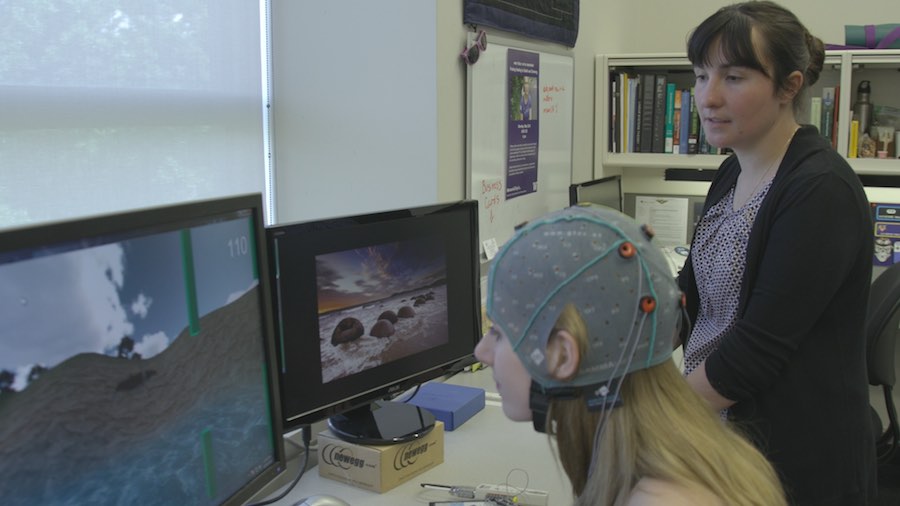
Motherboard’s Victoria Turk recently interacted with Howard Chizeck, who is working Tamara Bonaci, and her team. They strapped Turk into a BCI swimcap to play Flappy Whale and recorded her brainwaves. While doing so, the researchers were also sending messages to her brain.

Turk says that as she played along, something unusual started happening and the logos of American banks started appearing and disappearing.

Motherboard’s Victoria Turk with Tamara Bonaci
Researchers say that with this method, hackers can insert some images into apps and games, and record your brain’s response using the BCI. Doing so, hackers can know which banks they need to target or something more uncomfortable like your sexual orientation and fetishes.

The same technique can be implemented to read your mind for knowing your political or religious mindsets. Here’s what Bonaci has to say:

When you’re picking up electric signals to control an application… the application is not only getting access to the useful piece of EEG needed to control that app; it’s also getting access to the whole EEG,. And that whole EEG signal contains rich information about us as persons.

The researchers say that they haven’t perfected this art of mind-reading. But, they have been successful in reading people’s personal preferences based upon their strong emotional response. In such cases, after about 300 milliseconds of seeing a stimulus, there’s going to be a “positive peak hidden with their EEG signal.”

The researchers say that soon hackers will target people using fake and brain malware-packed games. Back in 2013, some researchers have already proved the possibility of side-channel attacks against BCIs, revealing private data like credit card pin, addresses, passwords etc.

The University of Washington researchers suggest that there should be a policy-oriented approach to figure out what’s acceptable to do with the data obtained from BCIs.

— Via Motherboard

Source: http://fossbytes.com/brain-malware-hackers-can-get-inside-head-bci/

Raspberry Pi + Docker: HypriotOS 1.0.0 Linux Brings Containers To Your Pi


HypriotOS 1.0.0 release recently arrived. It enables you to run Docker containers on entire Raspberry Pi family. HypriotOS is a Debian derivative that comes with out of the box Docker Engine 1.12.1. You need to simply install HypriotOS on your SD card using Hypriot flash tool and run a couple of commands to get this OS up and running.

If we take a look at some of the most impactful technology stories of the past few years, we can easily put Raspberry Pi, a tiny Linux-based single board computer, in the race. Earlier this year, we witnessed the launch of Raspberry Pi 3, a new version with built-in wireless and more powerful 64-bit processor.

This versatile computer already supported Linux-based operating systems and Windows 10 IoT Core. Recently we saw the release of HypriotOS v1.0.0 “Blackbeard”. It’s a new Debian derivative that’s developed to run Docker on your Pi.

Here’s what the official announcement on HypriotOS blog says:

“Today we proudly present our 1.0.0 release of HypriotOS – a container OS that takes you from Zero to Docker within 5 Minutes only, on any device of the complete Raspberry Pi family.”

It’s perhaps the first Linux distribution to offer Docker support for Raspberry Pi. Out of the box, HypriotOS v1.0.0 comes with Docker Engine 1.12.1 and the latest versions of Docker Machine and Docker Compose.

This lightweight operating system needs just 600MB of storage space to install and run. To get this OS up and running, you need to install HypriotOS flash tool and run the following command.

flash https://downloads.hypriot.com/hypriotos-rpi-v1.0.0.img.zip

After this, put your SD card into the Pi and turn on the power. After connecting to a Raspberry Pi, the booting up process just takes five minutes.

Here’s the download link: HypriotOS 1.0.0

HypriotOS 1.0.0 feature highlights:

  • Here are the major features of HypriotOS 1.0.0. Take a look:
  • Lastest Docker Engine 1.12.1 with Swarm Mode
  • All Raspberry Pi versions are supported
  • Easy flashing with HypriotOS flash tool
  • Easy installation and configuration
  • High performance out of the box
  • Enhanced security
  • Download package is just 232MB
Apart from this Docker integration, Raspberry Pi is also expected to be supported by Google’s upcoming operating system, Fuschia. Another important news comes from Redmond, that has just released the Anniversary update for Windows 10 IoT Core.

For more changes and detailed information about HypriotOS, please read the release notes.
Source: http://fossbytes.com/hypriotos-linux-distro-brings-docker-containers-to-raspberry-pi/

Rabu, 17 Agustus 2016

Microsoft Just Made Fun Of Apple In Its New And Hilarious Ad


In a new advertisement, Microsoft has made fun of Apple’s claim that iPad Pro is a real computer. Microsoft called Apple out on iPad Pro’s incompetence to run desktop apps and support USB devices. Looking at the devices offered by both the companies, at the moment, Microsoft Surface looks like a better “computer”.

Back in 2012, Apple CEO Tim Cook poked fun at Microsoft’s Surface tablet and called it “a fairly compromised, confusing product”. His other Apple colleagues thought that putting a keyboard on a tablet was like combining “a toaster and a refrigerator.” Well, things change with time.

Now, Apple is itself very much interested in the same business and working hard to push the sales of its iPad Pro. It’s so much engrossed in marketing iPad Pro as a computer that it has forgotten its real computer offering Apple MacBook Pro.

In an ad that people are calling silly, Apple recently implied that iPad is a complete replacement of a real computer. Given the current state of iPad Pro that comes with its mobile iOS operating system, this claim sounds childish. If you’ve missed the ad, here it is:


Now, poking fun at Apple’s claim, Microsoft has refused to accept the same. Redmond’s new Surface ad points out the problems faced by the iPad users who miss having USB port and not being able to run any desktop apps.

On the other hand, Microsoft’s Surface is more like a real computer with a complete desktop operating system and powerful hardware support.


Honestly, at the moment, if you want to do some real and serious work, Microsoft’s Surface is a better choice. We are waiting for Apple’s move because it’s an argument that won’t end here.
Source: http://fossbytes.com/microsoft-made-fun-apple-latest-ad-ipad-surface/

Jumat, 15 Juli 2016

Which Programming Languages Are Useful For Hacking


Important Programming languages for Hackers

Many of our readers often send us queries about which programming language they should learn. Some want to know quick fix hacking solutions. Almost all tech gadgets are built with coding. Every App, game or site that you use is programmed in a particular computer language. You need to know that hacking is not a click-of-a-button job but a serialized and compartmentalized vocation which uses different programming languages for different uses.

Most of the websites out there will give you list of most popular programming languages in the world. We at Techworm try to make it more easy for budding security researchers and hackers by breaking up the programming languages used by hackers.

Hacking is usually meant to break a code. There are three sections of hacking ― Web Hacking, Exploit Writing & Reverse Engineering and each of it requires different programming language


1. Web Hacking

Since most of the tech is build around world wide web, it is important to learn web hacking to be a good hacker. Let’s say you are interested in hacking web apps and/or websites then you will need to learn web coding. Websites use mostly HTML, PHP and JavaScript so it is important to learn these three.

HTML:

One of the easiest and widely used static markup web language present in each and every website you see in your browser. It’s recommended to learn HTML because it helps understanding web actions, response, and logic.

JavaScript:

JS is a client-side web programming mostly used in web sites for better user interface and quick response. If you are interested in a hacking career you need to learn JavaScript because it helps to understand client-side mechanism which is essential for finding client-side flaws.

PHP:

A dynamic server-side language which is responsible for managing web-apps and database. PHP is considered one of the most essential language because it controls everything on site and server, like a captain of a ship. It is advised to learn PHP nicely.

SQL:

SQL is responsible for storing and managing sensitive and confidential data such as user credentials, bank and personal information about the website visitors. Black hat hackers mostly target SQL database and steal information which is later sold on underground dark web forum. If you want to be good security researcher, you should learn SQL so that you can find flaws in a website and report them.

2. Exploit Writing

After web hacking, another most important feature of hacking is exploits. You can crack a particular software by writing a exploit. But to write a exploit you need to learn either Python or Ruby.

Python:

It is said that a security researcher or hacker should know Python because it the core language for creating exploits and tools. Security experts and even pro hackers suggest that master Python is the best way to learn hacking. Python offers wider flexibility and you can create exploits only if you are good in Python.

Ruby:

Ruby is a simple yet complicated object-oriented language. Ruby is very useful when it comes to exploit writing. It is used for meterpreter scripting by hackers. The most famous hacker tool, Metasploit framework is programmed in Ruby. Though Ruby may not be as versatile as Python, knowledge of Ruby is must in understanding exploits.

3. Reverse Engineering

Reverse engineering, the process of taking a software program’s binary code and recreating it so as to trace it back to the original source code. If you know reverse engineering you can find flaws and bugs easily. If you want to learn reverse engineering you need to know C, C++ and Java. The process of converting the code written in high level language into a low level language without changing the original program is known as reverse engineering.
Source: http://www.techworm.net/2016/06/programing-languages-used-hacking-process.html

Why “C” is The Default Drive Of Your Computer Instead Of A or B?


Once upon a time it was hard to own a computer. Having a computer was such a luxury no one could easily afford. But, nowadays the number of computer owners are increased dramatically than it was guessed by the inventors. and why not ? it is the most important machine today. In the present situation of Tech world, there is no wonder if anyone says that computer is an essential part of a human.

Though you may be using the computer for many days, most probably there would be many things which were unknown to you. If you are using the computer for many days, then here is a question for you.
Have you ever wondered why the names of drives start from “C”?.

Where had the A and B drives gone?


Here is the answer to the question:


  • Hard disk drives became standard since 1980.
  • Before hard disk drives, Floppy disk drives were used as the storage devices.
  • Floppy disk drives were the initial storage devices.
  • They came to existence since 1960’s. Floppy disks came in two sizes 5 1/4 ” and 3 1/2″.
  • Those two floppy disk drives were labelled as Local Disk (A) and Local Disk (B).
  • After the invention of Hard disk, a floppy disk of size 8 inch came into existence.
  • Presently Floppy disk drives and Floppy disk drives replaced the floppy disks.

This is the reason behind the labelling of hard drives. As a result, drives other than default drive (C) labelled as D, E etc. DVD drive and USB drive are labelled as F, G and so on. Though “C” drive comes as the default, you can change it to A or B if you have the administrative rights.
Source: http://www.damnnet.com/why-c-is-the-default-drive/

Fired From Facebook, Noah Kagan Talks About His Most Important Lesson


Ex-Facebook employee and the founder of AppSumo talks about what he learnt at Facebook during his 8-month work life. Noah Kagan tells about his past life in an interview with the NY Times bestseller Ramit Sethi.

Noah Kagan was an early bird in Facebook’s park. He was among the first fifty employees–30th, to be precise–to get a job at Facebook as a product manager when it had only a few million users. Kagan was shown the exit door of the company only after nine months from his joining.

The reasons, according to him, were fair enough for his firing. He leaked Facebook’s internal developments to TechCrunch and was working fine as well.

Kagan later became the founder of a marketing company known as AppSumo. The nine months he spent at Facebook did make a change in his life. A 2014 interview with the New Times bestseller Ramit Sethi throws light on what Noah Kagan learnt during his 8-month Facebook life.

Kagan recalled the instances when he approached Mark Zuckerberg with his ideas which would allow Facebook to make money. But it seemed Zuckerberg was more of a growth-seeker than money-centric. He would reply with something like, “Will it help Facebook Grow?”.

“When you are running your business, have one goal. That’s it.”


The one thing which Kagan learnt Facebook was to have one goal at a time. Kagan even helped Ramit to make his book “I Will Teach You to Be Rich” a bestseller.

Initially, Ramit’s book was composed of around 37 pages which were trimmed down to 5 after he took advice from Kagan. Kagan asked him about his one goal and Ramit said he wanted to make it to the NY Times bestsellers. And yes, he did that.

It is true, narrowing down your set of goals and choices would definitely point you towards the right direction, eventually, achieving what you desire. Multiple goals would distract you with different thoughts and separate focus would be required to achieve each one of them.

However, you can make your goals smaller and more realistic by splitting them for daily basis rather than running after annual goals.

Watch the excerpts of the interview:


Read more about Facebook:

Source: http://fossbytes.com/fired-facebook-noah-kagan-talks-one-thing-learnt/

Kamis, 30 Juni 2016

Man sues Apple for $10 billion for ‘stealing’ his designs for iPhone, iPad and iPod Touch

Florida man sues Apple for $10 billion for ‘stealing’ his iPhone designs from 1992

Apple’s lawsuit woes dont seem to ending anytime soon. A Florida man, Thomas S Ross has filed a lawsuit against Apple accusing the tech giant for stealing and using his own hand-drawn designs for an ‘Electronic Reading Device’ (ERD) that he conceived in 1992 for the design of its iPhone, iPad and iPod. Now, Ross man is suing Apple for over $10 billion (£7.5 billion). He also believes that he is owed “a reasonable royalty” of 1.5pc of all of Apple’s future sales.

Ross had filed a patent for an ERD, a rectangular, hand-held gadget with a screen, in 1992. In his lawsuit, he claims that he was “the first to file a device so designed and aggregated as to have created a novel combination of media and communication tools… whose identity was, since then, hijacked and exploited by Apple’s iPhones, iPods, iPads and others.”


Included in the lawsuit filing are drawings of Ross’s original patent conceived between May and September 1992. Ross claims Apple’s own reproductions “are substantially the same as his technical drawings of the ERD, and that Apple’s three-dimensional derivative devices (iPhone, iPod, iPad), embody the non-functional aesthetic look and feel”.


Among his submissions are a design for a further device – or likely a combination of two devices, known as the ‘Cypher-Text’, a ‘reading device’; and the ‘Cypher-Note’, a ‘writing device’ (shown below).

Ross’s patent was never actually approved, since he failed to pay the appropriate fees to the US Patent and Trademark Office, and the application was declared abandoned in 1995. However, he claims Apple resorted to “dumpster diving” when designing the iPhone and subsequent devices.

“Instead of creating its own ideas, Apple chose to adopt a culture of dumpster diving as an R&D strategy,” Ross’s lawsuit says.

It quotes Steve Jobs, who once said that “we have always been shameless about stealing great ideas”, and claims that Apple has caused Ross “great and irreparable injury that cannot fully be compensated or measured in money”. However, he may struggle to convince a jury that Apple pinched his concept.

Ross is demanding a jury hear a trial in the Florida Southern District Court. Ross v. Apple, Inc. was filed with the Florida Southern District Court on June 27. The case number is 0:2016cv61471.
Source: http://www.techworm.net/2016/06/man-sues-apple-10-billion-stealing-designs-iphone-ipad-ipod-touch.html

How To Hack WhatsApp Using SS7 Flaw


Researchers are easily able to hack WhatsApp and Telegram using the known telecom flaw


We continuously receive queries from readers about how to hack WhatsApp. The world’s most popular cross platform messaging App is seen to be ultimate hack by many because it has recently enabled 256-bit encryption.

For ordinary souls this encryption would take days and months to decode a sentence or a complete message. Ditto with another secure messaging service called Telegram. Though Telegram is not as popular as WhatsApp, it has its ardent group of followers who use it for its encryption as well as snooping free service.

Though both of these Apps are end-to-end encrypted both of them suffer from hardware side vulnerability which can be exploited to hack and hijack both WhatsApp and Telegram.

The vulnerability lies in Signalling System 7, or SS7, the technology used by telecom operators, on which the highly secure messaging system and telephone calls rely. SS7 is a set of telephony signalling protocols developed in 1975, which is used to set up and tear down most of the world’s public switched telephone network (PSTN) telephone calls. It also performs number translation, local number portability, prepaid billing, Short Message Service (SMS), and other mass market services.

SS7 is vulnerable to hacking and this has been known since 2008. In 2014, the media reported a protocol vulnerability of SS7 by which both government agencies and non-state actors can track the movements of cell phone users from virtually anywhere in the world with a success rate of approximately 70%. In addition, eavesdropping is possible by using the protocol to forward calls and also facilitate decryption by requesting that each caller’s carrier release a temporary encryption key to unlock the communication after it has been recorded. Researchers created a tool (SnoopSnitch) which can warn when certain SS7 attacks occur against a phone and detect IMSI-catchers.

You can view how researchers managed to hack WhatsApp and Telegram using the SS7 flaw below:

WhatsApp Hack


Telegram Hack


Both the hacks exploit the SS7 vulnerability by tricking the telecom network into believing the attacker’s phone has the same number as the victim’s phone. Once the network has been fooled, anybody, even a newbie can spy on the legitimate WhatsApp and Telegram user by creating a new WhatsApp or Telegram account using the secret code.

Once complete, the attacker now controls the account, including the ability to send and receive messages. Even more horrific is the fact that the hacker can also send messages on behalf of the victim, and read confidential messages intended for the victim without ever having to try to break strong encryption protocols.

See how easily you can hack WhatsApp and Telegram by fooling the network into believing your are the victim.
Source: http://www.techworm.net/2016/06/how-to-hack-whatsapp-using-ss7-flaw.html

Minggu, 26 Juni 2016

After Bill Gates, Now Zuckerberg Predicts The Future


Is Facebook’s founder and CEO trying to do a “Bill Gates” here??


Recently there was a wave of media attention around the predictions made by Bill Gates in his book ‘Business @the Speed of Thought’ that as of now, have come true. Now, this time Mark Zuckerberg shared his perception of the future. The Facebook chief said:

"People will still carry phones in their pockets, at least for the next 10 years, but they’ll also be wearing augmented-reality glasses to assist them on an everyday basis."

Let us take a look at his premonitions:


1. Telepathy


Wait, isn’t that science fiction!! Going by what Zuckerberg says, telepathy is the next logical step after virtual reality. The Facebook founder feels that technology is going to evolve to a limit that thought sharing would go to another level. The way we communicate our feelings and emotions will not include any physical medium per se.

Many scientists have already asserted the fact that one day we will be able to unleash the power of our brain to do unimaginable things, telepathy being one of them.

That means no more phone and data recharges. Of course, there may be another thing to charge in the future. Just imagine, talking to your friends through telepathy and laughing in public like crazy, while no one has a clue what has happened. Telepathy would bring in the final chapter in the textbooks of the communication technology.

2. Advanced Artificial Intelligence


Zuckerberg wants to create an artificial intelligence system that is so advanced that it exceeds the limit of human perception of seeing and hearing. An artificial intelligence system that views and understands the image contents as humans do.

The technology already exists today and is used in various places. Google Photos and Facebook’s face recognition are a few examples. However, Zuckerberg wants to take it to new levels where the machine can interpret and then describe an image or a video on its own.

3. Lasers From Sky


Mark Zuckerberg has an ambitious plan to get everyone hitched to Facebook and Internet and his internet Lasers are the way to do it. The company is working on laser communication systems that beam the internet down from the sky. The system will be attached to the drones and direct emission of the internet from the sky will hugely increase the speed over long distances and also cover the places that have not been wired yet.

4. Virtual Reality world


Telepathy is the talk of the future whereas Virtual Reality is NOW. Big names like Google, Microsoft (HoloLens), Epic Games including Facebook have ventured into the prospects of Virtual Reality. VR is already termed the “next big thing” and it is the next level of computing, gaming and communication after phones.

Facebook’s Oculus Rift is already making headlines with its Virtual Reality headset that is soon going to be available in the market.

5. Meta Humans


Again, consider this either as Zuckerberg’s fantasy or his philanthropy. In his recently held Q&A session on his Facebook timeline, he answered a question put up by Mr. Stephen Hawkins by his own plethora of questions. He sounded like he really wants to do something for the mankind.

He was mostly concerned about people, asked the genius how is it possible to live forever, how to cure all diseases and make our brain super smart to learn a million times more.

Well, it seems that with the ever advancing technology, most of the questions will be provided with an answer soon. While Mankind is bound to take a leap into the future and evolve to sustain itself, metahumans or superhumans won’t be a fiction then. That’s what Darwin proposed, isn’t it?
Source: http://fossbytes.com/after-bill-gates-now-zuckerberg-predicts-the-future/

Rabu, 22 Juni 2016

Photo reveals even Zuckerberg tapes his Webcam and Microphone for Privacy


What do you do to protect your 'Privacy' and keep yourself safe from potential hackers?

Well, Facebook CEO Mark Zuckerberg just need a bit of tape to cover his laptop webcam and mic jack in order to protect his privacy.

Yes, Zuck also does the same as the FBI Director James Comey.

Zuckerberg posted a photo on Tuesday to celebrate Instagram's 500 Million monthly user milestone, but the picture end up revealing about another security measure he takes to ensure that nobody is spying on him – and it's surprisingly simple.

Some eagle-eyed observers quickly noticed that the MacBook Pro on Zuckerberg's desk in the background of the image has the tape covering not only the webcam, but also the laptop's dual microphones.

While some tried to argue that it was not Zuckerberg's desk, Gizmodo pointed out that Zuckerberg has posted videos, live streams and images from there before, so it seems like a safe assumption.

So, Zuckerberg joins FBI director James Comey and NSA whistleblower Edward Snowden, who admitted that they tape their webcams.

Although some called this move paranoid, taping up your webcam is a simple and excellent precaution that cost nothing and has appeared many times in the past.

Keeping aside the controversies over Zuck's move, tapping your laptop's webcam is a good take away for you to adopt, because we know the ability of spy agencies, including the FBI and NSA (National Security Agency), to turn on webcam to spy on targets.

Edward Snowden leaks revealed Optic Nerve - the NSA's project to capture webcam images every five minutes from random Yahoo users. In just 6 months, 1.8 Million users' images were captured and stored on the government servers in 2008.

However, putting a tape over your webcam would not stop hackers or government spying agencies from recording your voice, but, at least, this would prevent them watching or capturing your live visual feeds.
Source: http://thehackernews.com/2016/06/tape-over-webcam.html

Selasa, 21 Juni 2016

Hackers Show How To Hack Anyone’s Facebook Account Just By Knowing Phone Number


Short: By exploiting the SS7 flaw, a hacker can hack someone’s Facebook account just by knowing the associated phone number. This flaw allows a hacker to divert the OTP code to his/her own phone and use it to access the victim’s Facebook account. The security researchers, who have explained the hack in a video, advise the users to avoid adding their phone numbers to the public services.

Facebook hacking is also one of the most commonly searched terms on the internet. However, very often people become a victim of malware while searching for Facebook hacking tools.

As we continue to deploy new safety measures to secure our online accounts, hackers and security researchers continue to find new ways to control Facebook accounts.

Recently, we told you how an Indian security researcher spotted a bug in the Facebook website and got $15,000 bug bounty.

Today, we are going to tell you how hackers can hack any Facebook account just by knowing the associated phone number and exploiting an issue with SS7 network.

For those who don’t know, SS7 network (Signalling System Number 7) is a communication protocol that’s used worldwide by the cellphone carriers.

Using a flaw in SS7, hackers can divert the text messages and calls to their own devices. This hacking technique has been shared as a proof-of-concept video by the security researchers from Positive Technologies.

How To Facebook Account By Knowing Phone Number (Video):

This flaw affects all Facebook users who have associated a phone number with their Facebook accounts.


In the demonstration video, the security researchers show that as the first step of the hack, the attacker needs to click on the “Forgot account?” button on Facebook.com website’s homepage.

When Facebook prompts the hacker to enter an email address or phone number, he/she should enter the correct number associated with the account.

By exploiting the SS7 flaw, the hacker is able to divert the OTP message from Facebook to his/her own computer and use it to login to the victim’s Facebook.

The researchers list some measures that a user can take to secure his/her Facebook account. They advise people to avoid adding their phone numbers to public services and rely on email for recovery purposes.

The users are also advised to use 2-factor authentication methods that don’t use SMS texts for sending OTP.
Source: http://fossbytes.com/facebook-hack-using-phone-number-ss7-flaw/

Senin, 13 Juni 2016

Microsoft To Buy LinkedIn For $26.2B In Cash, Makes Big Move Into Enterprise Social Media


Huge news today in the world of M&A in enterprise and social networking services:Microsoft has announced that it is acquiring LinkedIn, the social network for professionals with some 433 million users, for $26 billion, or $196 per share, in cash. The transaction has already been approved by both boards.

The $196 offer is a big hike on its closing price from Friday, $131.08. (And in premarket trading, unsurprisingly, it’s nearly crept up 64% to reach the share price MSFT is paying.)

LinkedIn is keeping its branding and product, and it will become a part of Microsoft’s productivity and business processes segment. LinkedIn’s CEO Jeff Weiner will report to Satya Nadella.

The acquisition is a big one for both sides.

For Microsoft, it’s bringing a key, missing piece into the company’s strategy to build out more services for enterprises. Today, the company is focused squarely on software (and some hardware by way of its very downsized phones business). LinkedIn will give it a far bigger reach in terms of social networking services and professional content — developing further along the lines of the communications products that it spearheaded with its acquisition of Yammer. It will give it a potential sales channel to sell more of its products, and will serve as a complement to those that it already offers for collaboration and communication.

“The LinkedIn team has grown a fantastic business centered on connecting the world’s professionals,” Nadella said in a statement. “Together we can accelerate the growth ofLinkedIn, as well as Microsoft Office 365 and Dynamics as we seek to empower every person and organization on the planet.”

For LinkedIn, it puts to rest questions of how the company would ever compete with companies that are building more software on top of their social graphs that would put it into closer competition against LinkedIn. For a while, it looked like this was the direction that LinkedIn hoped to develop, but more recent problems with user and revenue growth, and a subsequent dropping share price, has put the company on the defensive.

“Just as we have changed the way the world connects to opportunity, this relationship withMicrosoft, and the combination of their cloud and LinkedIn‘s network, now gives us a chance to also change the way the world works,” Weiner added in the statement. “For the last 13 years, we’ve been uniquely positioned to connect professionals to make them more productive and successful, and I’m looking forward to leading our team through the next chapter of our story.”

But this is not at all a story about a failing company getting scooped up on the way down for parts. LinkedIn, even with a share price that is below its 12-month high point of $258/share, is one of the better performing of tech companies in the public markets.

Microsoft has never been a massively successful company when it comes to social networking — although it smartly invested in Facebook before it went public. But this will give it its own foothold in this area.

LinkedIn is active in over 200 countries and has 105 million monthly active users, with 433 million registered overall. The company has some 60% of all traffic on mobile, and — thanks to some strong SEO — a crazy 45 billion quarterly page views. It’s also one of the biggest repositories of job listings, with some 7 million active listings currently. While some parts of LinkedIn’s business has stagnated, specifically with MAU growth (which is up only 9% on last year) latter is a growing business — up 101% on a year ago.

LinkedIn’s core business is based today around recruitment ads and, to a lesser extend, premium subscriptions for users. The recruitment business (termed “Talent Solutions”) accounted for $2 billion of the company’s $3 billion in revenues in 2015.

And as you can see from the photo above, Reid Hoffman, one of the co-founders and current chairman, is behind the deal.

“Today is a re-founding moment for LinkedIn. I see incredible opportunity for our members and customers and look forward to supporting this new and combined business,” said Hoffman in a statement. “I fully support this transaction and the Board’s decision to pursue it, and will vote my shares in accordance with their recommendation on it.”

The companies are hosting a conference call at 8.45AM Pacific time. Below is the presentation deck they will use:


Source: http://techcrunch.com/2016/06/13/microsoft-to-buy-linkedin-for-26b-in-cash-makes-big-move-into-enterprise-social-media/

Kamis, 02 Juni 2016

Samsung: “Don’t Install Windows 10 Because We Suck At Making Drivers”


Short: Samsung, one of the world’s largest PC-makers is asking its customers to avoid Windows 10 upgrade. The company isn’t doing so due to some Windows 10 privacy concern or spying issue. Instead, Samsung is unable to provide the updated drivers for Windows 10 operating systems and advising its users to stay away from it.

Microsoft is leaving no stone unturned to convince people to use its latest operating system by pushing the free Windows 10 installation offer for all Windows 7 and Windows 8.1. The company didn’t hesitate to make sneaky attempts to slip Windows 10 update into the systems.

Well, the free Windows 10 upgrade offer is coming to an end this July 29. As a result, Redmond wants more and more people to shift to this new operating system in the next two months. Meanwhile, if you are willing to grab the free upgrade even after July 29, Microsoft has left a little window open and we’re also here to help you with a trick.

Read Must:
 Microsoft Faces Over 10 Million Attacks Everyday

But, Microsoft bosses definitely won’t be happy with Samsung, one of the largest makers of personal computers. The South Korean tech giant is actually advising its customers to ditch the Windows 10 upgrade.

If you are wondering about the reason behind this advice by Samsung, it’s related to Samsung’s own incompetency. To run any piece of software on your machine, you need to make your hardware compatible by installing proper drivers.

To run any piece of software on your machine, you need to make your hardware compatible by installing proper drivers.

Many users have reported fragile functioning of vital features like wireless and Bluetooth after upgrading to Windows 10. Surprisingly, a user has received a frank email from the company saying that Samsung doesn’t recommend anyone to update its machines to Windows 10.

The company also fails to provide some deadline for the certified drivers for Windows 10 and asks the people to contact Microsoft.

Being one of the biggest consumer electronics companies around, it has the resources to test and develop new drivers. However, the company chooses to ignore the complaints and such negligence from an OEM like Samsung is completely unacceptable.
Source: http://fossbytes.com/samsung-advises-users-dont-install-windows-10-drivers/

Minggu, 29 Mei 2016

Microsoft Is Banning Your Stupid And Lazy Password


Short: To stop you from using insecure passwords that are easy to guess and crack, Microsoft has activated the Dynamic Password Banning system in its Microsoft Account Service and Azure AD. The company is also using the Smart Password Lockout feature to restrict the bad guys from accessing your account.

Having a strong password is one of the most important points in the steps to effective security. It’s not a difficult task but very often we feel lazy and decide to use dumb passwords like “12345” or “qwerty”.

Since people can’t stop using these commonly used passwords in their email accounts and other important places, Microsoft is going ahead and banning them. In simple words, if you think you can use “password” as your password, you’ll have to try another email service.


Microsoft has prepared this list by collecting data from more than 10 million daily account attacks. This change is also important as it comes in the wake of the recent leak of whopping 117 million LinkedIn credentials.

While LinkedIn has invalidated those passwords, it’s a well-known fact that people are habitual of using the same password for using up different services. Well, if you need a simple guide on how to create the super-strong passwords,we’ve got it.

If people will try to use a banned password, it’ll show a notification asking you to “choose a password that’s harder for people to guess.”


Microsoft’s new Dynamic Password Banning has been put in place in Microsoft Account and Azure AD system. This service is already live in Microsoft Account Service and in private preview in Azure AD, Microsoft tells. Over the course of the next few months, all 10 million Azure AD accounts will be getting the benefit of this enhanced security layer.

Microsoft will continuously update its password banning system by analyzing the latest data leaks and including the new common passwords.

Microsoft has also talked about its Smart Password Lockout system that detects a bad guy trying to guess your password and lock that account.

Get your free guide on creating an unbreakable password here.

Sabtu, 28 Mei 2016

Google’s VirusTotal Can Now Scan Your Firmware For Infection

Short: Google is in the process of adding a new anti-malware detection program in its online malware detection tool VirusTotal. It will be used for scanning BIOS for the legitimate programs installed on it. VirusTotal will also use machine learning to learn from the program behavior and hence finding out the malware.

Latest National Security Agency revelations by Snowden involves many secrets regarding the projects involving infecting BIOS firmware. Apart from the NSA, there are more examples of attempts to inject malware into the firmware of the computer.

Until now, the Antivirus industry has not made anything to detect the malware in the BIOS. BIOS is loaded into memory at the beginning of the boot process. That’s why the main operating system code resides on a memory chip soldered onto the mainboard. Thus, BIOS becomes one of the most targeted virus attacks as the code is loaded into the machine before the startup of the operating system.

This makes a malware residing on the firmware almost impregnable and virtually impossible to detect. They can survive system reboots, system wiping and reinstallations of the operating systems. Until now the firmware malware has been ignored a lot in the Antivirus industry but, Google’s VirusTotal may well change this.

VirusTotal will categorize the BIOS into either a legitimate or a malicious BIOS image. VirusTotal can scan all the operating systems including Windows and Apple Mac BIOS to obtain relevant information about the code on the Flash tool. It uses heuristic detection which is based on machine learning to identify the suspect code as well as looking up for the legitimate executable applications built into the BIOS.

Sometimes, the BIOS manufacturers put a computer legitimate program like computer trace programs. These programs help an owner of the machine to trace the computer in case of lost. VirusTotal will extract these executable files and submits them to the service. It will also enable a user to look into the details of the legitimate executable programs.
— VirusTotal Blog
Source: http://fossbytes.com/googles-virustotal-can-now-scan-firmware-infection/

Jumat, 20 Mei 2016

Learn Hacking From Phineas Fisher, The Hacker Who Cracked Hacking Team Servers


Phineas Fisher who cracked the Hacking Team publishes a detailed video about how to hack


After hitting headlines for donating $11000 in bitcoins to an anti-ISIS group in Syria, Phineas Fisher is back in news. Phineas Fisher or Hack Back is the alias of the hacker who pwned the websites of spying gadgets and surveillance software providers Hacking Team and Gamma Group.

After indulging in philanthropy with stolen money, Phineas Fisher has decided to teach interested wannabe hackers on how he hacks into websites. He has released a “how-to” video, detailing various hacking techniques.


The hacking tutorial video released by Phineas Fisher presents step-by-step process of his latest hack, the Spain’s Catalan police union website called Sindicat De Mossos d’Esquadra (SME).

Phineas Fisher is not new to this sort of thing. Earlier, after his mega exploit of pwning Hacking Team, Phineas Fisher had made public a similar video detailing how he hacked into Hacking Team’s servers and quietly stole all of their most sensitive data which almost crippled them. You can see the earlier tutorial here.

You can rest assured that Phineas Fisher is a pro as far as hacking is concerned because at the time of writing this article, the Swiss police union website is down as detailed in the hack. Phineas Fisher also leaked the stolen data online but was later removed by the hosting service.

As you have probably guessed by now, Phineas Fisher wants to be looked upon as a social justice warrior aka Robin Hood of the Internet. To push forward his social justice agenda, Phineas Fisher also defaced SME’s Twitter account and posted images of people who were beaten by over-zealous SME officers.

The video of the Hacking Tutorial by Phineas Fisher posted on YouTube has been removed by Google at the time of writing of this article however you can view it on the alternative sources tweeted by him.

Kamis, 19 Mei 2016

This 14-Year-Old Boy CEO Rejected $30 Million Offer For His “RecMed” Innovation


Short: Taylor Rosenthal, a young innovator from Alabama says that he has turned down a $30 million buyout offer from a large company. He is the founder of a RedMed, a company that makes first aid dispensing vending machines. Rosenthal came up with this innovative idea when he was working on a eighth-grade project.

A14-year-old boy has come up with the innovative idea of a first aid dispensing vending machine. This genius boy, Taylor Rosenthal, from Alabama, has said that he rejected a $30 million buyout offer from a “large national healthcare company”.

It looks like the young inventor is ready for the big leagues. He is also the youngest person to ever get accepted for giving a demo at TechCrunch Disrupt.

Rosenthal launched his startup RecMed in 2015. He has already gained $100,000 in angel investments. This first aid dispensing machine was started as an eighth-grade project when he was a part of a Young Entrepreneurs Academy class.

Talking about the source of inspiration of this business idea, he tells that he needed to come with a business idea in that class.

“Every time I’d travel for a baseball tournament in Alabama, I’d notice that kids would get hurt and parents couldn’t find a band-aid,” he told CNN Money. “I wanted to solve that.”

To solve this problem, initially, he tried to set up a pop-up shop that would sell first-aid kids to the players. Realising that this isn’t the best model, he prepared a new design and took some advice from his parents, who already work in the medical industry.

By December, he was successful in obtaining a patent by preparing a prototype that worked.

Now, he plans to sell the machines for $5,500 each. These first aid kid dispensing vending machines come with first aid kits and basic medical supplies like gloves, plasters, gauze pads etc. that cost $4-$11.

Over the summer, Rosenthal plans to deliver these machines to beaches, stadiums, and amusement parks. As a start, Six Flags theme park has already placed an advance order for 100 machines.


Source: http://fossbytes.com/taylor-rosenthal-boy-ceo-founder-recmed-first-aid-dispensing-vending-machine/